Who Were the Parents of Philander McCarter?
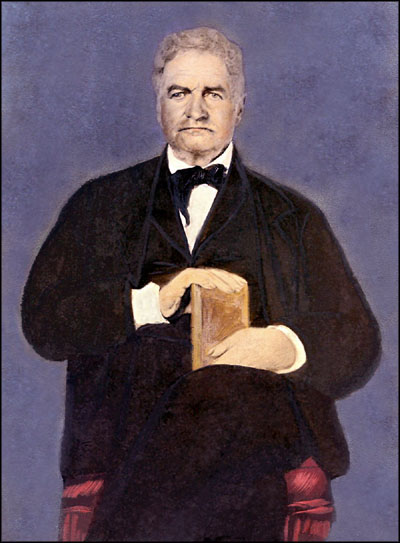
Philander C. McCarter (1802-1870)
Courtesy of Judy McCarter Modica
Philander McCarter was born in New York on February 21, 1802, but his exact birth place, parents, and siblings, if any, remained a mystery.
Philander was 25 when he first appeared in New York records. On April 16, 1827 he paid $300 for 32 acres in the township of Denmark, Lewis County, New York where he was living at the time. There were no witnesses to ths deed suggesting that Philander may have been new to the area.
Nevertheless, less than fifteen miles from Denmark are the towns of Lowville and Martinsburg where brothers Clark and Langford McCartey, orginally of Colchester, Connecticut, settled in the early 1800s. Clark's children are well documented, but Langford's are not.
In the 1810 census Langford and his wife, Philura Gates were listed in Lewis County with 10 children including four males under the age of 10. Could Philander, who was eight, have been one of their boys?
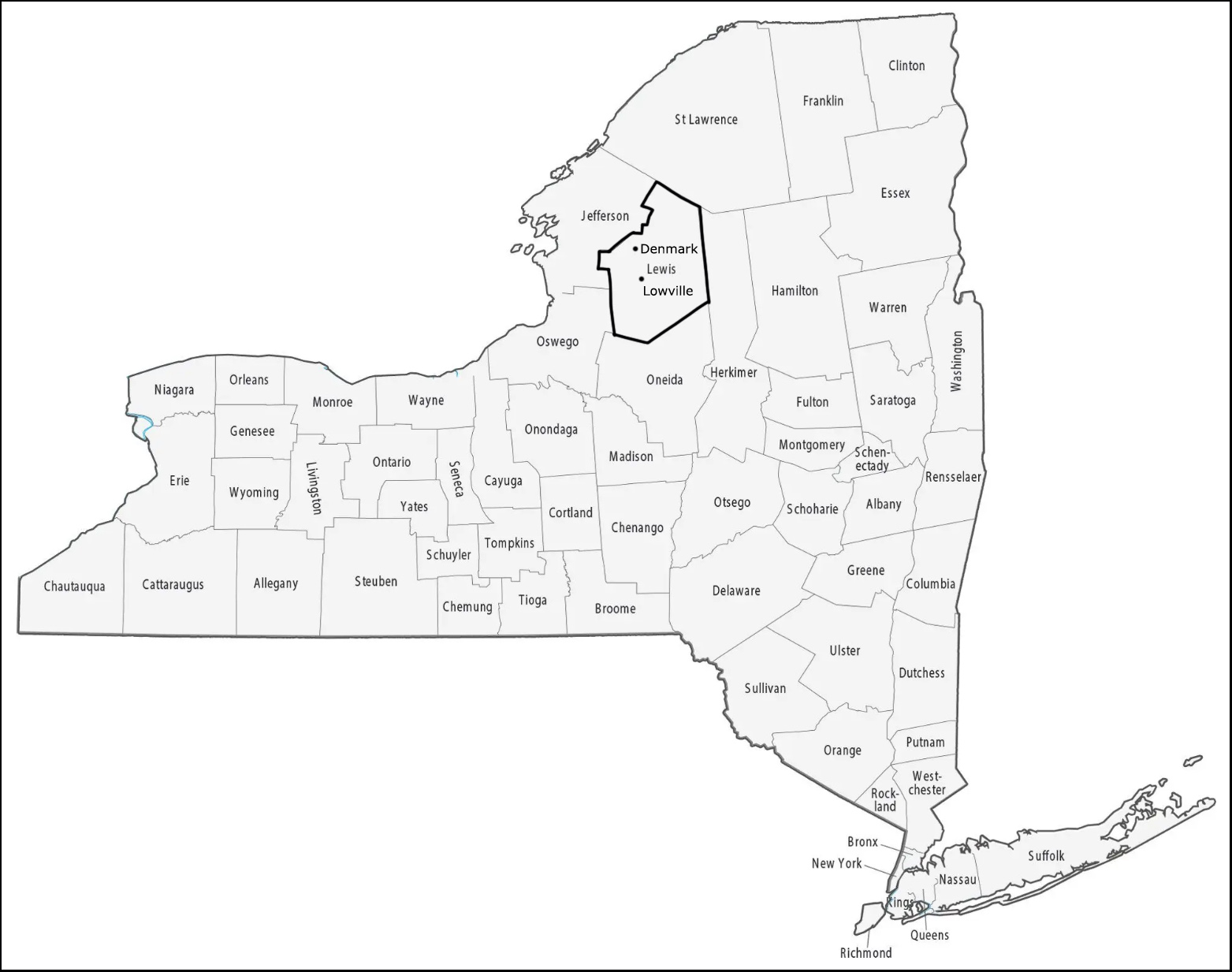 Lewis County, New York
In the spring of 1813 Langford, 54, and Philura, 42, died just a few days apart from spotted fever (likely bacterial meningitis) which was rampant in New England at that time.
The epidemic may have taken even more family members because only two of Philura and Langford's 10 children have been documented. They are the oldest and youngest sons, George Henry McCartey (1794-1869) and Guy Carleton McCartey (1806-1891). Both Henry and Guy married and raised large families on their farms in Lewis county where they remained for the rest of their lives.
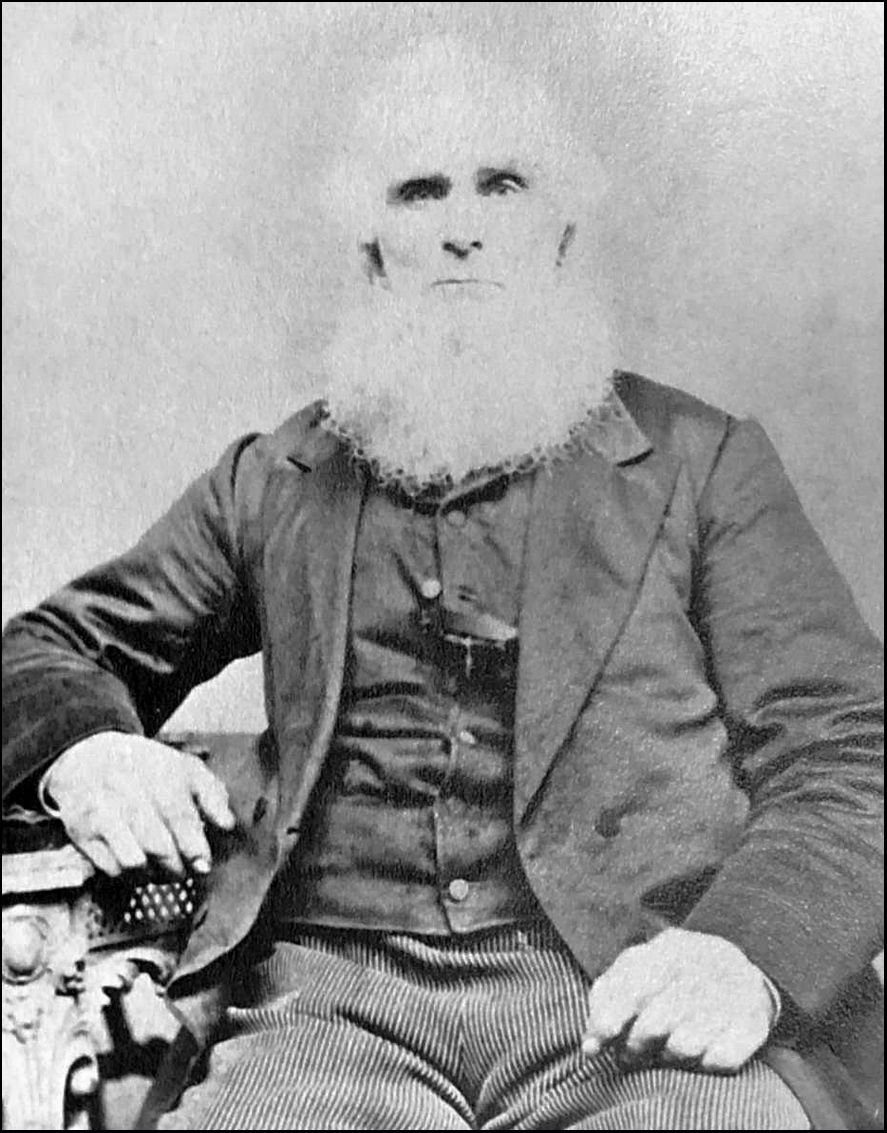
Guy Carleton McCartey (1806-1891)
Courtesy of Jeffrey A. Nelms at FamilySearch.org
Because early records from Lewis County are sparse, we decided to turn to DNA to see if there might be a McCartey-McCarter connection. Unfortunately research into the direct male descendants of both Clark and Langford turned up no living McCartey males, so Y-DNA testing is out. We have also yet to have any autosomal DNA matches with McCartey descendants, but research is ongoing, as always.
Philander next appeared on a property tax list for Grayson County, Virginia. On March 10, 1832 he was assessed a six cent tax on his horse. In September he bought a tract of land on Elk Creek.
A few months later he married Thurza Williams, and they raised a large family in Grayson and, later, just over the state line in Ashe County, North Carolina.
Philander died on February 9, 1870 at the age of 67 and was buried on his farm in Grassy Creek. His original grave marker is the only record of his date of birth.
Our first and, for many years, only clue to Philander's origins came from a family history written in the late 1970s by his granddaughter Kate (McCarter) Weaver. In this history, Kate recounted her mother, Mary Jane (Senter) McCarter, saying that Philander came to Grayson County as a tinware salesman from New York state and that everyone called him "Honest John" even though his name was Philander (pronounced PHIL-an-der). According to Mary Jane, he was a "wood's colt" or illegitimate child.
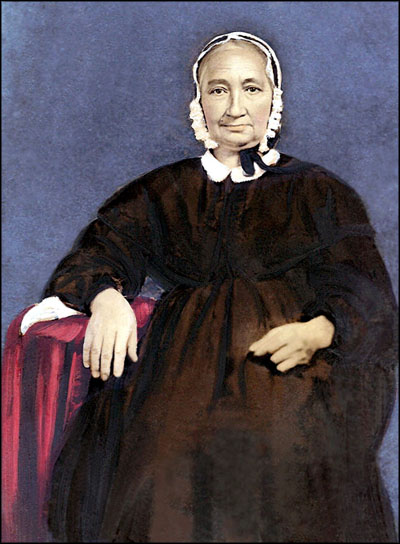
Thurza McCarter (1808-1898)
Courtesy of Judy McCarter Modica
In the late 1980s, inspired by the McCarter descendants research of Connie (Robbin) McCarter, we began talking to distant cousins from California to Virginia about Philander's early history. We came up empty-handed so turned to records research.
We had completed most of the research below when a second family story emerged from a Bertine descendant in 2012. While the story confuses Philander for his probable father, James, the 200-year-old oral history closely parallels our research.
According to this Bertine descendant, a "Philander McCarty" of NYC was sued in 1803 for having fathered three children out-of-wedlock. One of the women who took him to court was Elizabeth Bertine who lived in the Tribeca neighborhood. She was said to have left him around 1805 and, with her child, moved to northern Westchester County.
In 2015, a descendant of Philander and Thurza's daughter Catherine "Jane" (McCarter) Cornett posted a photo of the Cornett family on the McCarter facebook page with this notation on the back — (Margaret [sic] Cornet was a McCarter from New York City, from a family of merchants.)
These few family clues support years of research which point to Philander having been the illegitimate child of Mary Fenton and James McCarter, grocer, of New York City. At the time of Philander's birth in 1802, James was the husband of Elizabeth (Paulding) Bertine and they lived in what is now the Tribeca neighborhood. James' brothers, Arthur and John McCarter, were also NYC grocers.
In her family history, Kate (McCarter) Weaver said, "Thursie married Phineas [Philander] McCarter after buying his bond from someone who brought him over from Scotland as a bound servant." It could be that Kate was one generation off and it was the widow, Elizabeth (Pauliding) Bertine, who bought James McCarter's indentured servant contract beore marrying him. While there is no evidence that James was an indentured servent, we do know that both of his brothers were.
Court and census records support Philander's New York merchant origins. On August 23, 1837 the Grayson County court directed Stephen Hale, John Sutherland, and Philander with proposing "... the opening of a new road, the nearest and best route from McCarter's store to the top of Buck Mountain." Two years later, Philander was taxed on a herd of seven horses suggesting that he may have also been doing a little horse trading.
In the 1840 census he was listed as being "employed in commerce" and was the postmaster for Elk Creek. In both the 1850 and 1860 census, after turning to farming, he gave his birth place as "New York." (1)(2)
What follows is our ongoing research into the Fentons, McCarters, and Bertines of NYC from 1800-1860. Because of gaps in early record-keeping, lost and destroyed records, and the McCarter's propensity to die intestate, we may never have absolute proof of Philander's parentage, but we continue to search.
Records from 1800-1810
Two years before Philander's birth, only twelve McCarter families appeared in the 1800 census of the state of New York. New York City – the second largest city in the nation behind Philadelphia – had a population of just 60,000.
In the 1810 census, there were nineteen McCarter households in the state of New York. Nine had a male child under 10 (Philander being 8), but only one of these seems to fit the circumstances described by his daughter-in-law Mary Jane Senter. That was the household headed by Irish immigrant James McCarter (1766-1818) of New York City.
Note: James was born in Ireland according to this record and New River Notes gives the McCarter's origins as Ulster. Family tradition is that we are Scots-Irish. Given that James was Presbyterian, it could well be that the McCarters had been Scottish settlers in Ulster before coming to America aka Scots-Irish.
The story begins eight years earlier on October 8, 1802 when James McCarter is named as the father of Mary Fenton's child in a suit by the City for support under the "Act for the Relief of Cities and Towns from the Maintenance of Bastard Children."
The timing is right for Philander, who was born eight months earlier on February 21, 1802. Unfortunately there are no records showing the name, sex, or birth date of Mary Fenton's child.
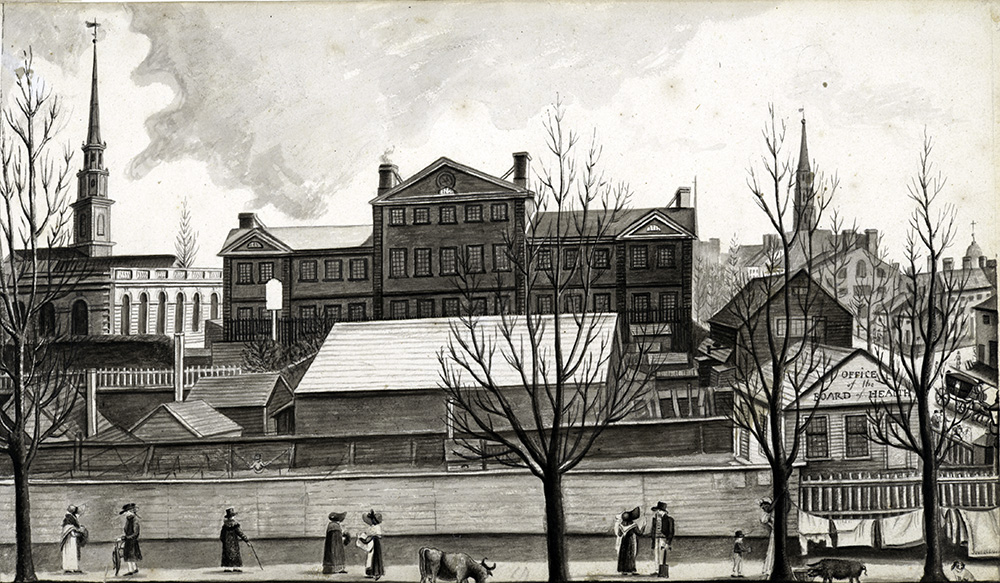
Bridewell and Charity-School,
Broadway, opposite Chamber Street, 1808
Baroness Hyde de Neuville watercolor from the New York Public Library
The bastardy case was heard nearly a year later on August 3, 1803 with Anthony Day representing the City and the Commissioners of Almshouse and Bridewell (seen above). James lost the case and was ordered committed until he paid the Commissioners $20.06 for the cost of caring for his out-of-wedlock child.
The People's witnesses were Mary Fenton, Katy Johnson, Margaret Fenton, and James T. Mary (Murry/Murray) — likely the same James Murray who worked with James' brother, Arthur McCarter, as an apprentice to Charles Christian.
James was again brought to court by the commissioners of the Almshouse in 1804, 1809, and 1811. In the last suit he was ordered to pay $81.06 to the Almshouse. This suggests that his child probably survived to at least age nine and that James was still paying maintenance, but probably not directly caring for the child. It's more likey that the child was with Mary until she disappeared in 1805, then perhaps returned to the Almshouse orphanage.
In 1803 and 1804, New York City directories show Mary keeping a boarding house on Leonard Street where it would have been possible for her to raise her child. Assuming that this child was Philander, his survival alone suggests that he was in the care of his mother for the first few years of life because foundlings raised by the City rarely survived infancy.
Click map to enlarge.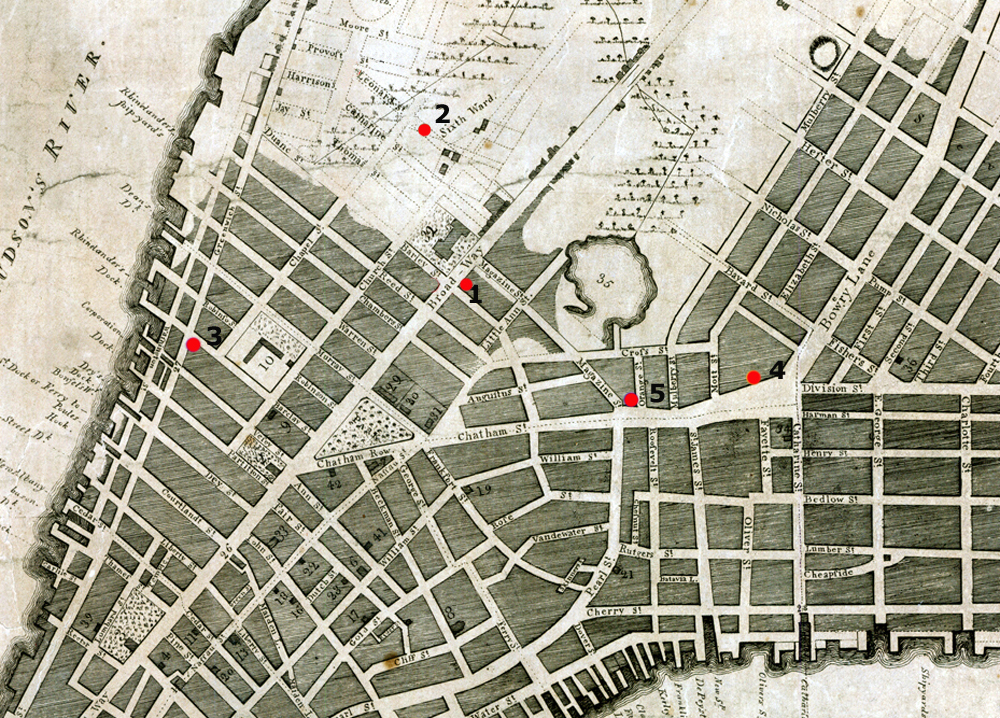
Old Map of New York City 1) James and Elizabeth McCarter's house at 304 Broadway, 1800. 2) Mary Fenton's boarding house on Leonard, 1803. 3) James' grocery store at 149 Greenwich, 1806. 4) James' grocery stores at 16 and 52 Chatham Square, 1807-13. 5) James' home at 50 Orange, 1811-18.
At the time James McCarter was named as the father of Mary Fenton's child, he was married to Elizabeth (Paulding) Bertine (1772-1859) and working as a grocer at the corner of Broadway and Barley (now Duane) in Lower Manhattan.
James and Elizabeth had been married on August 14, 1800 at the Presbyterian Church. Elizabeth was the daughter of Cornelius Paulding (1735-1817) and the apparently wealthy widow of Peter Bertine (1760-1797), a brewer, with whom she had four children Catherine, Peter, Jane, and Deborah.
On November 26, 1800 with a mortgage from her brother-in-law, James Bertine, Elizabeth and James bought a house on the corner of Broadway and Barley that James had been renting from George McKay. This was likely the property at 304 Broadway which later appears in Elizabeth's estate records.
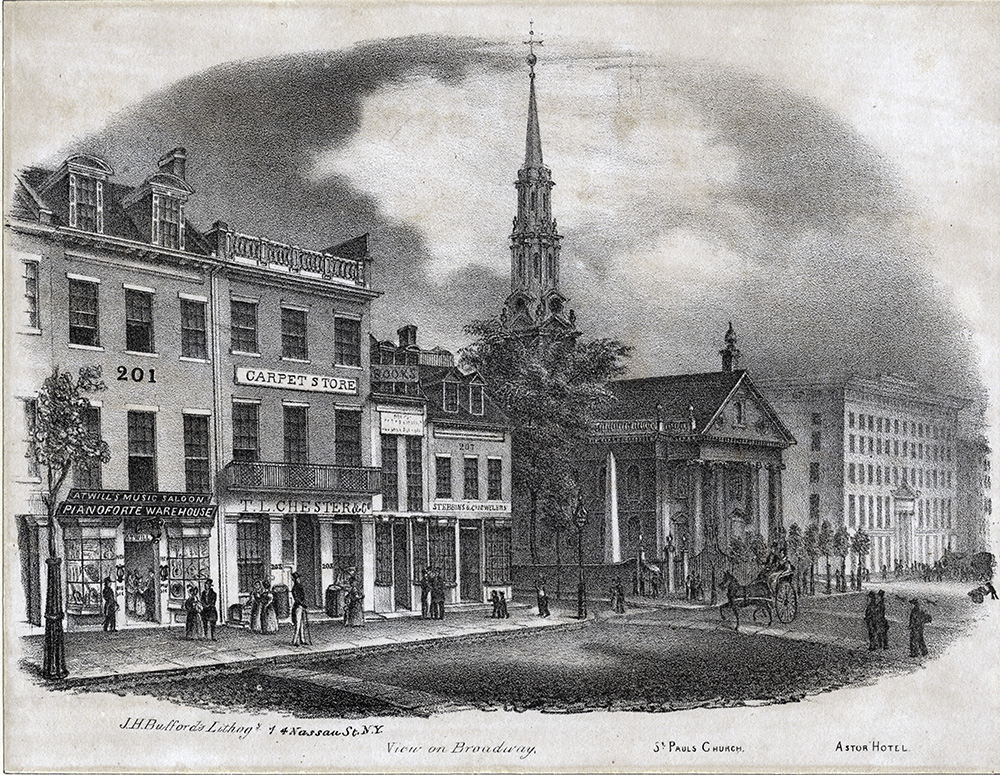
View of Broadway (200 Block), 1801
John Henry Bufford (1810-1870) lithograph from the New York Public Library
The James McCarty household in the 1800 census had three males 26-45, one female 26-45, and one girl under 10. The census was taken ten days before James' marriage to Elizabeth, so doesn't appear to include her or her four children.
Who are the other two men ages 26-45, the woman age 26-45, and the girl under age 10 in James' household?
James' brother Arthur McCarter (1777-1840), who married Cornelia Somerindyke at the Trinity Church Parish on May 23, 1805 would have been 23 at the oldest according to his War of 1812 records.
James' other brother, John McCarter (1777 -1824), on April 28, 1800 was listed as a 23-year-old grocer from Ireland when declaring his intention to become a citizen.
So although Arthur and John would have been younger than 26, they seem to be the most likely male members of the household.
Who, though was the woman age 26-45 and the female child under 10?

Broadway and Trinity Church, 1830
John William Hill (1812-1879) watercolor from the New York Public Library
On April 4, 1804 Margaret Fenton, who had been a witness at the bastardy hearing eight months earlier, was indicted, but plead not guilty to keeping a disorderly house. She was convicted and fined $40 plus the costs of prosecution for petty larceny.
Margaret was most likely Mary's mother. A Robert Venton and Margaret Adams had a daughter Mary who was born on December 23, 1780 and baptised in the Dutch Reformed Church in Albany. At the same time a Robert and Margaret Fenton are found in New York City records. Robert was a brass founder who disappeard from NYC records after 1794. He may have died or left for parts unknown leaving Margaret alone and desperate.
Disorderly house charges against women usually, but not always, involved prostitution. Employment options for single women in early NYC were limited and wages were deplorably low. They could work as cooks, laundresses, seamstresses, and maids for another household, or perform all of the above by running a boarding house of their own. It is not surprising that some would have turned to prostitution as a means of survival.
Exactly one month after Margaret was fined for running a disorderly house, a legal notice appeared in the American Citizen newspaper in which she petitioned that an insolvent Mary Fenton be discharged from her debts. Had the large fine led to the closure of a boarding house that Margaret and Mary had been running together?
On August 10, 1804 Mary was the sole defendant’s witness in the trial of Euphemia Chambers who was indicted with Henry Duff, John Flinn, and Patrick Armond for grand larceny of the goods of Andrew Mathieu. Euphemia was found guilty.
On February 16, 1805 the New York Spectator newspaper reported that Mary was on trial for "willful and corrupt perjury" most likely related to the trial of Euphemia Chambers. The jury found the witnesses to be of "general bad character" so Mary was released and ordered to appear at the next session of the court to undergo a new trial.
Mary disappears from all records after this 1805 incident. Her child would have been just three-years-old at the time. In 1807 Margaret is listed as living at the corner of Barley and Broadway. On August 11, 1807 Margaret, Samuel Martin, and William Browne were indicted on conspiracy charge with no mention of the victim or the crime's intention.
On January 14, 1806, James McCarter was indicted for assaulting his wife Elizabeth. He was ordered to find a surety to supervise him, to report to the court from day-to-day, and to put up a $200 bond.
At the time James had a grocery at 249 Greenwich. John McCann, who had a tavern on Greenwich, must have agreed to be James surety because he was required to put up $100 bond. Elizabeth allowed the court supervision to end four months later on May 29, 1806.
"On an indictment from the sessions for assaulting and beating his wife Elizabeth McCarter. The said Elizabeth McCarter appeared in court and acknowledged satisfaction whereupon it was ordered that the said James McCarter be discharged."
It appears that they separated during this period because city directories show that James was no longer living in the family home at 304 Broadway, and the 1810 census of James' household shows only two males over age 45 and one male 10-15. Further evidence of their estrangement is Elizabeth returning to the use of her first husband's surname when she appears in the 1817 Minutes of the Common Council as "Mrs. Bertine" the owner and landlord of 304 Broadway with a "nuisance privy."
Records from 1810-1820
In the 1810 census, Margaret Fenton, age 45 or older, was living living alone in ward 1, coincidentally next to Anthony Day, Attorney for the Commissioners of the Almshouse and Bridewell. It's possible that she was actually living in the Almshouse, although the census records don't mention the institution.
On February 6, 1811, Margaret was convicted of Grand Larceny and sentenced to three years and a day in the state prison. This is her last appearance in NYC records.
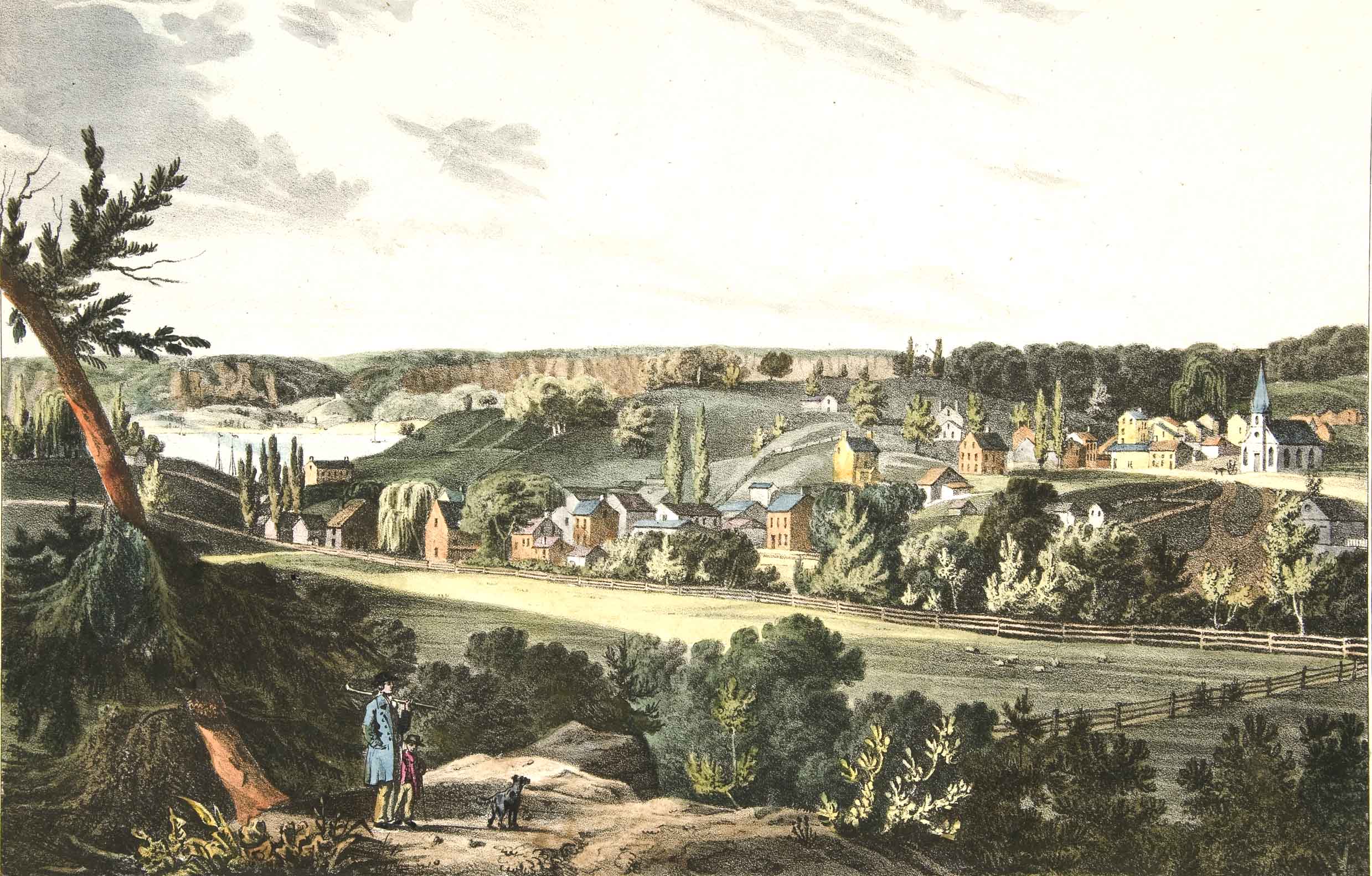 Manhattanville, 1834
John William Hill (1821-1879) colored lithograph
James' brother Arthur McCarter does not appear in the 1810 census, but in 1811 he bought three lots of land (80, 82, and 84) on the corner of Manhattan Street in Manhattaville where he and Cornelia lived for the next 22 years. Manhattanville, also known as West Harlem, was one of Manhattan's first suburbs and sat at Bloomingdale Road and Manhattan Street (now Broadway and 125th).
After the British invaded Washington, D.C. in August of 1814 and five British war vessels were spotted off the coast of Sandy Hook, a call went out for volunteers to better fortify and protect NYC. Arthur served from July through December as a sergeant in Captain Daniel Smith's Company of Colonel Jasper Ward's Second Regiment of the New York Militia.
The militia worked day and night to construct additional breastworks, blockhouses, and forts. Fort Laight was built on a rise overlooking Manhattanville just a little over 100 yards from where Arthur and Cornelia's home stood. Probably because of its fortifications, NYC was spared attack and an end to the War of 1812 was negotiated on December 24, 1814.
There are no records showing that either James or John McCarter joined the regular army or the militia during the war.

The red dot shows the approximate location of
Arthur
and Cornelia McCarter's home in Manhattanville under the watch of Ft. Laight.
The James McCarter household in 1810 was located in the 4th ward, and had just two men over the age of 45, and one boy in the 10-15 bracket. Philander would have been just 8, but the census taker could have made an error when checking the columns. It's also possible that James' child was in the orphanage because he was taken to court by the Almshouse commissioners for payment the following year.
Around 1807 James McCarter had moved his grocery store to 52 Chatham and then six years later to 16 Chatham opposite the County Jail and Arsenal. Since the mid-1700s, Chatham Square had served as the city's horse market, but in 1805 the Common Council permitted the sheriff to hold auctions there. Others soon obtained permits and the square became active with auctions featuring new and used household goods such as crockery, baskets, and furniture. The city's merchants and storekeepers formed societies for preventing sales by auction, and by March 1820 all Chatham Square auction permits were revoked. But the action came too late for James whose business apparently suffered.
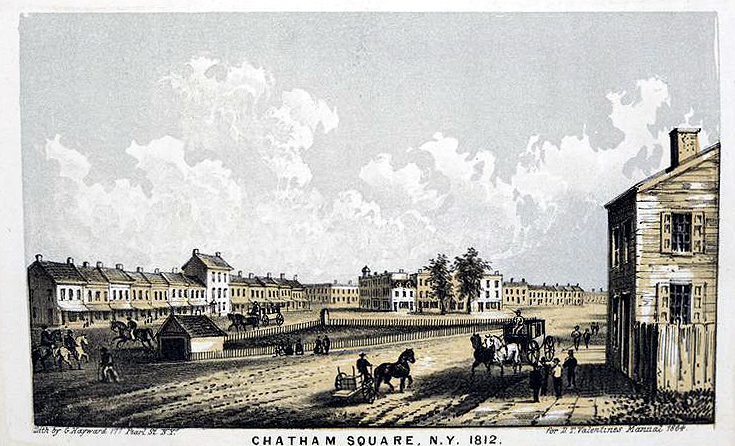
Chatham Square, New York City, 1812
George Hayward, Lithographer from the New York Public Library
On August 18, 1813 the Supreme Court in Albany ruled against James in a case brought by William Cummings, also a grocer. James owed William $600.00 plus court costs of $15.25 and the Court ordered the Sheriff to auction off his property to help settle the debt. On July 29, 1814 his property on Chatham was seized and sold by the sheriff for $200.00 to help satisfy the judgment.
Less than one month before this judgment, James had taken out a mortgage on property at 50 Orange Street near what was later to become the infamous Five Points Neighborhood. James must have retained his home on Orange where he is later listed as a millwright apparently having soured on the grocery business.
He died on 28 Nov 1818 at the age of 52 of bilious fever which was probably malaria or viral hepatitis. He was buried in the Old Brick Presbyterian Church Cemetery on Beekman Street. (The church was demolished in 1854 and remains of those in the cemetery were relocated to the Cemetery of the Evergreens in Brooklyn.)
Because he died intestate, Letters of Administration were granted to his brother Arthur who was given six months to settle his brother's estate. On December 5, 1818, according to an Inventory Index 1783-1834, Arthur took an inventory of James' estate with appraisers John Moore and James Anderson.
No further probate records were found, but Arthur must have complete his duties because in April 1819 Elizabeth began selling off some of their property.
Elizabeth McCarter NYC Land Conveyances
| Grantors | Grantees | Lib. |
Page |
Date of Instrument |
When Recorded |
| Elizabeth McCarter | Thomas Allen | ||||
| Elizabeth McCarter | William Ross | ||||
| Elizabeth McCarter | John Penn | 171 |
398 |
20 DEC 1823 |
20 DEC 1823 |
| Elizabeth McCarter | Deborah Field | 420 |
344 |
29 Oct 1841 |
3 Nov 1841 |
| Grantees | Grantors | Lib |
Page |
Date of Instrument |
When Recorded |
| Elizabeth | Mary Bertine | 167 |
300 |
27 Jun 1823 |
1 Jul 1823 |
| Elizabeth | Wm. S. Ross | 168 |
304 |
27 Jun 1823 |
1 Jul 1823 |
| Elizabeth | Peter Bertine | 170 |
91 |
26 Aug 1823 |
20 Oct 1823 |
| Elizabeth | Thos. & George Lovett | 172 |
111 |
23 Oct 1823 |
23 Oct 1823 |
| Elizabeth | Abraham Houseman |
213 |
206 |
15 Jan 1827 |
16 Jan 1827 |
Records from 1820-1830
What became of John McCarter is not entirely clear. He appears in no records after the 1810 census and was not involved in James' 1818 probate. So he may have left New York City, or he may have been the John McCarter listed in New York Deaths and Burials who was born about 1779 in Ireland and died June 7, 1824 in NYC and was buried in Potter's Field.
From November 1, 1816 to May 1, 1819, Arthur McCarter rented a pew at the Reformed Dutch Church of Harlem. In the 1820 census his family is found still living in Manhattanville. His household consists of 1 male 26-45 (Arthur), 1 female 26-45 (Cornelia), and 1 female 10-16 perhaps a daughter or servant? So no evidence of his possible 18-year-old nephew Philander.
Records from 1830-1840
In the 1830 census Arthur appears in the 12th ward which had been carved out of the 9th and 10th wards in 1825, so the family was apparently still living in Manhattanville.
His household consists of two males ages 40-49, Arthur and (?), one female 40-49, Cornelia, and one male child 5-9, their son William born circa 1822.
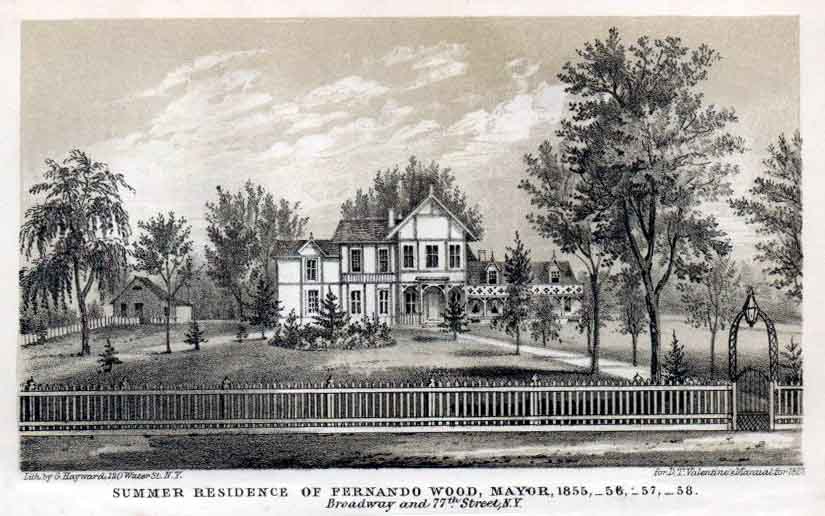
Home of Arthur and Cornelia McCarter
at 77th Street and Broadway, NYC
after it was remodeled by Mayor Fernando Wood, from the New York Public Library
In the mid-1830s Manhattanville was becoming industrialized which may have been what prompted Arthur and Cornelia to move. In July 1833 they sold their three lots on Manhattan Street to Henry Gratacap and moved to the three acres of property that she had inherited from her father, Richard Somerindyke. Their home sat on the NW corner of 77th Street and Bloomingdale Road (later Broadway) on McCarter Lane.
The Somerindykes were an old Dutch family who had settled a great farm in the early 1700s on what is now the upper west side of NYC from 59th street into the upper 70s and from Broadway west to the Hudson River.
Records from 1840-1850
From the Letter of Administration on his estate, we know that Arthur McCarter died intestate sometime before June 8, 1840 at the age of 63. Eight years after Arthur’s death, Cornelia and her son William sold their home and most of its surrounding land to Fernando Wood and moved to Baltimore.
A few years later, after becoming the mayor of NYC, Wood added to the south side of the house and named his country seat Woodlawn. In 1860 he hosted a lunch there for former President Millard Fillmore and 18-year-old Edward VII, Prince of Wales during his grand tour of the U.S. and Canada.
Cornelia McCarter and Fernando Wood are both mentioned in this passage from The New York of Yesterday, Hopper Striker Mott, Putnam's, 1908 - Bloomingdale (N.Y.), p. 425.
Running over an elevation, dignified by the title of "hill," we saw a small cottage where lived the widow McCarthy [sic] and then reached the next store, kept by Jacob Tripp. When Fernando Wood became Mayor, he took possession of the ground where these three last-named houses stood, and turned it into an immense lawn and drive. He had his residence on the site of the widow McCarthy's [sic] house.
Arthur and Cornelia McCarter NYC Land Conveyances
An apparently well-off Arthur and Cornelia purchased and sold many pieces of property in NYC between 1811 and 1848.
| Grantee | Grantor | Lib. |
Page |
Date of Instrument |
When Recorded |
| Arthur | Robert Morris | 270 |
381 |
27 Apr 1811 |
17 Mar 1831 |
| Arthur | John Somerindyke | 253 |
521 |
18 Oct 1811 |
11 Aug 1829 |
| Arthur | James C. Somerindyke | 173 |
98 |
19 Nov 1822 |
5 Feb 1824 |
| Arthur | John Ginter | 167 |
281 |
28 Jun 1823 |
28 Jun 1823 |
| Arthur | William Wagstaff | 270 |
384 |
25 Oct 1826 |
17 Mar 1831 |
| Arthur | Daniel Cashman | 263 |
230 |
14 Jan 1830 |
25 May 1830 |
| Arthur | Sarah Curtis | 260 |
628 |
9 Apr 1830 |
1 May 1830 |
| Cornelia | John W. Newson | 438 |
245 |
2 Oct 1843 |
4 Oct 1843 |
| Cornelia | Richard Schieffelin | 455 |
605 |
18 Mar 1845 |
19 Mar 1845 |
| Grantor | Grantee | Lib |
Page |
Date of Instrument |
When Recorded |
| Arthur | Daniel Cashman | 260 |
626 |
1 Dec 1829 |
1 May 1830 |
| Arthur | Daniel Cashman | 260 |
622 |
1 Dec 1829 |
1 May 1830 |
| Arthur | Henry Gratacap | 302 |
304 |
15 Jul 1833 |
18 Jul 1833 |
| Mortgage to H. Gratacap | 163 |
94 |
18 Jul 1833 |
18 Jul 1833 |
|
| Arthur | Henry Wilkes | 333 |
2 |
30 Apr 1835 |
1 May 1835 |
| Mortgage to Lewis B. Reed | 194 |
361 |
8 Mar 1836 |
1 Apr 1836 |
|
| Cornelia | John Newson | 432 |
268 |
23 Jan 1843 |
24 Jan 1843 |
| Cornelia | Jacob W. Tripp | 439 |
301 |
21 Oct 1843 |
13 Nov 1843 |
| Cornelia | Fernando Wood | 507 |
341 |
8 Jul 1848 |
11 Jul 1848 |
| Cornelia | Fernando Wood | 508 |
365 |
12 Aug 1848 |
15 Aug 1848 |
| Cornelia | Fernando Wood | 508 |
367 |
12 Aug 1848 |
15 Aug 1848 |
Records from 1850-1860
James' wife Elizabeth (Paulding) Bertine McCarter died March 16, 1859 in New York City. She left a lengthy will that took two years to probate and bequeathed property and funds to her children, grandchildren, and even her friends.
Cornelia (Somerindyke) McCarter and her son William moved to Baltimore shortly after they sold all of the property in NYC. Cornelia likely died circa 1855 in Baltimore as she does not appear in the 1860 census with William and his family.
William, who was possibly Philander's only cousin, was a gardener who had three children. John Frederick was born to his first wife (name unknown) in New York circa 1844. With his second wife, Elizabeth "Jane" McHale, he had two children Arthur b. 1855 and Lizzie b. 1861. Young Arthur died before reaching adulthood, and Lizzie die at about age 21.
William died in Baltimore in 1867 at the age of 45 and Elizabeth in 1911 at age 82. An article on Elizabeth's death mentions no living relatives, so what became of her stepson John Frederick is unknown. The only clue is an 1891 newspaper ad placed in a Harrisburg, Pennsylvania newspaper which reads as follows:
Information wanted of John Frederick McCarter and Emeline McCarter, nee Newson, formerly of Baltimore. Address James A Deering, Attorney-at-Law, 96 Broadway, New York.
The Somerindykes and Newsons intermarried years earlier in NYC, so John Frederick and Emeline may have been distant cousins. The only other possible survivor on Arthur's line is the as yet unidentified 10 to 16-year-old female who appeared in the 1820 census of his household.
Timeline of Events
Notes
1. Only 14 of the over 1,500 households in Grayson were employed in commerce in 1840. The storekeepers were predictably scattered throughout the farming community with the exception of Philander and Charles Dougherty, who were practically next-door neighbors. Could Charles and Philander have been partners in the store, and if so, might their families have known each other back in New York?
Charles was born 1805 in Guilford County, North Carolina to Samuel Dougherty and Dorcas Flack. The only other Dougherty in Grayson County census records was Elizabeth Daugherty born October 29, 1777 in New York. She was the wife of Daniel Daugherty born November 7, 1770 and died April 6, 1843. Samuel and Daniel were both living in Guilford County in 1820. Were they brothers and did they also come from New York like Daniel's wife Elizabeth?
An ethnicity analysis of the 1850 census at New River Notes shows that only six of Grayson County's families came from New York, and only two of these immigrated from Ireland – the McCarters and Doughertys. More research may reveal a connection between these families in New York and help solve the mystery of Philander's parentage.
2. Other McCarters in the Grayson County area were William McCarter, who appeared in the 1842 Carroll County, Virginia Personal Property Tax List. There were also William and Lidia McCarter, ages 66, who appeared in the 1860 census of the North Fork District of Ashe County, North Carolina whose birthplaces were given as North Carolina. Nothing more on these McCarters could be located.
Sources Checked
New York Historical Records Collection at familysearch.org.
Trinity Church Parish Records in New York City
New York Newspapers at fultonhistory.com.
New York State Records at Ancestry.com.
Early New York City Directories at fold3.com.
Early New York City Newspapers at GenealogyBank.com.
The New York Genealogical & Biographical Society eLibrary.
NYC Record Books Researched
Ancestry.com. Minutes of the Common Council of the City of New York, 1784-1831 [database on-line]. Provo, UT: The Generations Network, Inc., 2005.
Scott, Kennneth. Denizations, Naturalizations, and Oaths of Allegiance in Colonial New York. Baltimore: Genealogical Publishing Co., 1975.
Scott, Kenneth. Early New York Naturalizations: Abstracts of Naturalization Records from Federal, State, and Local Courts, 1792-1840. Baltimore: Genealogical Publishing Co., 1981.
Scott, Kenneth. Genealogical Data from Colonial New York Newspapers: a Consolidation of Articles from the New York Genealogical and Biographical Record. Baltimore: Genealogical Publishing Co., 1977.
Scott, Kenneth and James Owre. Genealogical Data from Inventories Of New York Estates, 1666–1825. New York: New York Genealogical and Biographical Society, 1970.
Scott, Kenneth. Genealogical Data from New York Administration Bonds (1753-1799). New York: New York Genealogical and Biographical Society,1969.
Scott, Kenneth. Genealogical Data from the New York Post Boy, 1743-1773. Washington, D.C.: National Genealogical Society, 1970.
Scott, Kenneth and Leo Hershkowitz. Index of Original Wills (1776-1829). New York: National Genealogical Society, 1967.
Scott, Kenneth. New York City Court Records, 1760-1797: Genealogical Data From the Court of Quarter Sessions. Washington, D.C.: National Genealogical Society, 1983.
Scott, Kenneth. New York City Court Records, 1796-1801: Genealogical data from the Court of General Sessions. (Special Publications, No. 56). Arlington, Virginia: National Genealogical Society, 1988.
Scott, Kenneth. New York City Court Records, 1801-1804: Genealogical Data from the Court of General Sessions (Special Publications, No. 57). Arlington, Virginia: National Genealogical Society, 1988.
Scott, Kenneth. New York Marriage Bonds 1753-1783. New York: Saint Nicholas Society of the City of New York, 1972.
NYC Records Researched
NYC Birth Certificates for Philander (none as early as 1802)
NYC Church Records* for James, Mary, or Philander (nothing found)
NYC Almshouse Census, Admission, Dischard and Death Records for Mary and Philander. Nothing found from 1800 through 1820 probably because records are not complete. Files searched were REC0008 01-160, 161 and 01-211, 212 and 02-166, 167, 168, 169, 170, 171, 172, 173, 174, 175, 176, 177 and 02-185, 186, 187 and 02-214
NYC Court Records
NYC Mayor's Court Records for the year 1802 for the original case Mary brought against James on October 8, 1802 (nothing found)
Index to Guardian Bonds and Letters of Guardianship A-Z 1808-1864 New York County Surrogates Court - FHL 907913 (No Fentons or McCarters found)
Guardians Bonds 1802-1806 FHL 912733 (No McCarters or Fentons found)
Letters of Guardianship Vol. 1 and Vol. 2-6 1811-1819, New York County Surrogates Court - FHL 1704620 (No Fentons or McCarters found)
New York County Chancery Court Minutes Vols. 7737-7738 1801-1807 - FHL 590391 (Mary Fenton applying for bastardy support was not found)
New York County Supreme Court Minutes 1801-1805 - FHL 1018644 (Only Fenton found "Davis Newland vs. Granville Smith and Peter Fenton")
New York County (New York) County Clerk Court Sessions, V. 11, 12 1796-1807; FHL Film 497587 (James charged with assaulting Elizabeth.)
"New York, Naturalization Index, 1792-1906," images, FamilySearch (https://familysearch.org/pal:/MM9.3.1/TH-1961-29866-66360-59?cc=2043782&wc=9D3W-W38:1067796601 : accessed 06 May 2014), Roll 169, McGuire, John-McCarthy, David > image 1 of 5214; citing NARA microfilm publication M1674, National Archives and Records Administration, Washington, D.C. (Searched all Soundex M263 but found no McCarters).
"New York, Southern District, U.S District Court Naturalization Records, 1824-1946", images, FamilySearch (https://familysearch.org/pal:/MM9.3.1/TH-1951-34581-19265-47?cc=2060123&wc=M5P4-N3V:351565501 : accessed 01 Apr 2014), Naturalization index 1824-1852 vol 1, A-Z > image 1 of 39. (No Fentons or McCarters found)
New York Surrogates Court, Miscellaneous orders (1803-1870), Orders bundle 1 (1803-1839) - FHL 909250 (Loose records with only 2 for 1803, No Fentons or McCarters found)
New York Surrogates Court Petitions and Accounts 1803-1888 - FHL 913407 and 913409 (FHL 913407 only included the years 1832-1862, FHL 913409 had miscellaneous records early than 1820, but no McCarters found)
NYC Probate Records
"New York, Probate Records, 1629-1971," images, FamilySearch (https://familysearch.org/pal:/MM9.3.1/TH-1942-28666-47826-7?cc=1920234&wc=M9S9-K31:1213302834 : accessed 11 Feb 2014), New York > Accounts 1810-1862 E-F > image 1 of 1068. (Accounts not in Decrees. No Fentons found.)
"New York, Probate Records, 1629-1971, New York Accounts 1810-1862 M" images, FamilySearch (https://familysearch.org/pal:/MM9.3.1/TH-1942-28663-53171-45?cc=1920234&wc=M9S9-K73:n2113083436 : accessed 09 Jan 2014), New York > Accounts 1810-1862 M. (Accounts not in Decrees. No McCarters found.)
"New York, Probate Records, 1629-1971," images, Family Search ( https://familysearch.org/pal:/MM9.3.1/TH-1961-28643-7421-32?cc=1920234&wc=M9S9-KWB:n866946327 : accessed 08 Jan 2014), New York, Administration bonds 1838-1840 vol 35-37, image 713 of 731. (Arthur McCarter found.)
"New York, Probate Records, 1629-1971," images, FamilySearch (https://familysearch.org/pal:/MM9.3.1/TH-1971-28665-15416-12?cc=1920234&wc=M9S9-KW8:n1994596800 : accessed 12 Feb 2014), New York > Administration bonds 1766-1798 vol E-I > image 1 of 1167. (Searched 1795-1798. No Peter Bertine.)
"New York, Probate Records, 1629-1971," images, FamilySearch (https://familysearch.org/pal:/MM9.3.1/TH-1971-28618-5544-8?cc=1920234&wc=M9S9-RRQ:1379167987 : accessed 13 Feb 2014), New York > Decrees index 1830-1907 A-N > image 1 of 488. (No early Fentons or Bertines. Only Elizabeth in McCarters.)
"New York, Probate Records, 1629-1971," images, FamilySearch (https://familysearch.org/pal:/MM9.3.1/TH-1942-28664-41838-15?cc=1920234&wc=M9S9-RR1:n1502704802 : accessed 13 Feb 2014), New York > Dower records 1831-1856 > image 1 of 101. (No Fentons or McCarters.)
New York County Surrogates Court, Executors Renunications 1816-1818 - FHL 911774 and Executors Renunciations 1819-1823 - FHL 911775 (Elizabeth McCarter handed over executorship of James' estate to his brother, Arthur McCarter)
"New York, Probate Records, 1629-1971," images, FamilySearch (https://familysearch.org/pal:/MM9.3.1/TH-1942-28505-17625-25?cc=1920234&wc=M9S9-RT1:n475590333 : accessed 08 Feb 2014), New York > Inventories 1783-1834 > image 2057 of 3831. (Index of Inventories. No Peter Bertine or Fentons, but James McCarter found.)
"New York, Probate Records, 1629-1971," images, FamilySearch (https://familysearch.org/pal:/MM9.3.1/TH-1971-28616-17871-94?cc=1920234&wc=M9S9-YMS:202781411 : accessed 09 Feb 2014), New York > Letters of administration index 1743-1910 A-C > image 1 of 564. (No entry for Peter Bertine who died circa 1797)
"New York, Probate Records, 1629-1971," images, FamilySearch (https://familysearch.org/pal:/MM9.3.1/TH-1971-28643-15785-88?cc=1920234&wc=M9S9-TS1:n1330361911 : accessed 14 Feb 2014), New York > Letters of administration 1795-1798 vol 5 > image 1 of 656. (No Peter Bertine.)
"New York, Probate Records, 1629-1971," images, FamilySearch (https://familysearch.org/pal:/MM9.3.1/TH-1971-28663-20346-38?cc=1920234&wc=M9S9-T4F:n1505706143 : accessed 14 Feb 2014), New York > Letters of administration 1817-1819 vol 16 > image 221 of 605. (James McCarter found.)
New York Surrogates Court Miscellaneous Probate Records 1800-1830 - FHL 909302 (No McCarters or Fentons found)
"New York, Probate Records, 1629-1971," images, FamilySearch (https://familysearch.org/pal:/MM9.3.1/TH-1942-28665-39686-93?cc=1920234&wc=M9S9-YCM:n564031102 : accessed 12 Feb 2014), New York > Miscellaneous probate records 1800-1830 > image 1 of 1151. (Actually 1800-1839. No McCarters or Fentons found.)
"New York, Probate Records, 1629-1971," images, FamilySearch (https://familysearch.org/pal:/MM9.3.1/TH-1961-28665-24316-96?cc=1920234&wc=M9S9-BST:n229718523 : accessed 14 Feb 2014), New York > Orders index 1830-1882 > image 1 of 530. (Found James and Peter Bertine and Elizabeth McCarter).
"New York, Probate Records, 1629-1971," images, FamilySearch (https://familysearch.org/pal:/MM9.3.1/TH-1961-28663-25809-90?cc=1920234&wc=M9S9-YZV:n1451044761 : accessed 09 Feb 2014), New York > Orders 1803-1839 bundle 1 > image 1 of 407. (No orders for James McCarter found.)
"New York, Probate Records, 1629-1971," images, FamilySearch (https://familysearch.org/pal:/MM9.3.1/TH-1942-28664-13819-33?cc=1920234&wc=M9S9-Y6W:1975009316 : accessed 14 Feb 2014), New York > Orders 1838-1844 vol 9 > image 171 of 817. (Order for Arthur McCarter found).
"New York, Probate Records, 1629-1971," images, FamilySearch (https://familysearch.org/pal:/MM9.3.1/TH-1942-28670-1681-63?cc=1920234&wc=M9S9-B3S:1183993216 : accessed 15 Feb 2014), New York > Petitions 1803-1888 > image 1 of 3811. (Miscellaneous Petitions 1804-1816 so no James McCarter found.)
"New York, Probate Records, 1629-1971," images, FamilySearch (https://familysearch.org/pal:/MM9.3.1/TH-1971-28665-37660-96?cc=1920234&wc=M9S9-14Y:1191325327 : accessed 15 Feb 2014), New York > Proceedings index 1800-1872 > image 1 of 75. (James McArthur listed. Couldn't find in bundles.)
"New York, Probate Records, 1629-1971," images, FamilySearch (https://familysearch.org/pal:/MM9.3.1/TH-1961-28663-40216-21?cc=1920234&wc=M9S9-1VS:305195844 : accessed 10 Feb 2014), New York > Renunciations index 1830-1912 > image 1 of 147. (No Fentons or McCarters found.)
"New York, Probate Records, 1629-1971," images, FamilySearch (https://familysearch.org/pal:/MM9.3.1/TH-1961-28616-33691-40?cc=1920234&wc=M9SS-9B3:n813847877 : accessed 09 Feb 2014), New York > Wills index 1662-1910 vol A-D > image 1 of 608. (No Peter Bertine, Bartine, etc.)
"New York, Probate Records, 1629-1971," images, FamilySearch (https://familysearch.org/pal:/MM9.3.1/TH-1971-28617-14187-4?cc=1920234&wc=M9SS-9B7:89665291 : accessed 09 Feb 2014), New York > Wills index 1662-1910 vol E-H > image 1 of 591. (No early Fentons.)
"New York, Probate Records, 1629-1971," images, FamilySearch (https://familysearch.org/pal:/MM9.3.1/TH-1942-28617-19982-94?cc=1920234&wc=M9SS-9B4:163369504 : accessed 09 Feb 2014), New York > Wills index 1662-1910 vol I-Mc > image 439 of 553. (Only Elizabeth McCarter has a will.)
"New York, Probate Records, 1629-1971," images, FamilySearch (https://familysearch.org/pal:/MM9.3.1/TH-1961-28664-40255-43?cc=1920234&wc=M9SS-9BF:n1896332252 : accessed 10 Feb 2014), New York > Wills index 1807-1926 > image 1 of 94. (Rejected Wills. No McCarters or Fentons).
Wills and Administrations New York Vol. 42-44 1796-1804 - FHL 484025 (No McCarters or Bertines found)
Petitions and Accounts, and Proceedings are completely disorganized. Revisit after they have been indexed.
NYC Land Records
"United States, New York Land Records, 1630-1975", database with images, FamilySearch (https://www.familysearch.org/ark:/61903/1:1:7FCQ-JYN2 : 22 October 2020), Philander McCartey in entry for Moses Wetmore, 1836.
"New York, Land Records, 1630-1975," images, FamilySearch (https://familysearch.org/pal:/MM9.3.1/TH-1961-33068-8754-51?cc=2078654&wc=M9M4-G17:458348279 : accessed 05 Mar 2014), New York > Conveyance index-grantee 1654-1866 D-H > image 264 of 769. (Some Fentons - no Margaret or Mary.)
"New York, Land Records, 1630-1975," images, FamilySearch (https://familysearch.org/pal:/MM9.3.1/TH-1951-33076-20666-71?cc=2078654&wc=M9M4-G1Z:n1458867139 : accessed 05 Mar 2014), New York > Conveyance index-grantee 1654-1866 I-M > image 399 of 696. (Found Arthur, Cornelia, and Elizabeth McCarter.)
"New York, Land Records, 1630-1975," images, FamilySearch (https://familysearch.org/pal:/MM9.3.1/TH-1971-32681-16269-30?cc=2078654&wc=M9M4-5BS:n1169136900 : accessed 05 Mar 2014), New York > Estate accounts 1805, 1820-1829 > image 1 of 211. (No McCarters or Fentons.)
"New York, Land Records, 1630-1975," images, FamilySearch (https://familysearch.org/pal:/MM9.3.1/TH-1942-33207-2534-63?cc=2078654&wc=M9M4-R7C:22074169 : accessed 24 Jan 2014), New York > Grantor index 1681-1825 M (Searched for McCarters. Found three entries for Elizabeth.)
"New York, Land Records, 1630-1975," images, FamilySearch (https://familysearch.org/pal:/MM9.3.1/TH-1961-33207-4541-40?cc=2078654&wc=M9M4-R71:270676903 : accessed 24 Jan 2014), New York > Grantor index 1825-1863 vol M (Searched for McCarters to 1850. Found a few entries).
"New York, Land Records, 1630-1975," images, FamilySearch (https://familysearch.org/pal:/MM9.3.1/TH-1961-33208-3195-20?cc=2078654&wc=M9M4-51H:1090278254 : accessed 27 Jan 2014), New York > Grantee index 1682-1847 M (Searched for McCarters. Found many entries.)
"New York, Land Records, 1630-1975," images, FamilySearch (https://familysearch.org/pal:/MM9.3.1/TH-1942-32681-16261-75?cc=2078654&wc=M9M4-RC5:1965094223 : accessed 22 Jan 2014), New York > Insolvent assignment index 1754-1855 (Certificates of Sherrifs' Sale: Arthur McCartee administrator of James McCartee deceased, date of filing certificate 3 Aug 1821)
"New York, Naturalization Index (Soundex), 1792-1906," images, FamilySearch (https://familysearch.org/pal:/MM9.3.1 /TH-1961-29866-66360-59?cc=2043782&wc=9D3W-W38:1067796601 : accessed 08 Oct 2014), Roll 169, McGuire, John-McCarthy, David > image 1 of 5214; citing NARA microfilm publication M1674, National Archives and Records Administration, Washington, D.C. (Searched Soundex M263 and found no Arthur, James, or John McCarter)
New York County Surrogates Court, Proceedings in the Sale of Real Estate, Index to the Proceedings in the Sale of Real Estate, 1800-1872 - FHL 912835 (James "McArthur" Bk. 9, p. 190, Bundle 30 ) Proceedings M, FHL 910903, 910904, and 910905 (Bundles did not correlate with index, James McArthur could not be found).
"New York, Land Records, 1630-1975," images, FamilySearch (https://familysearch.org/pal:/MM9.3.1/TH-1951-33070-6476-18?cc=2078654&wc=M9M4-RCB:n2062373488 : accessed 09 Mar 2014), New York > Mortgagee index 1752-1890 vol F > image 1 of 889. (Searched for Fentons.)
"New York, Land Records, 1630-1975," images, FamilySearch (https://familysearch.org/pal:/MM9.3.1/TH-1942-33073-20882-77?cc=2078654&wc=M9M4-RZY:n883177610 : accessed 06 Mar 2014), New York > Mortgagee index 1764-1870 vol M > image 1 of 844. (Checked for McCarters up to 1860)
"New York, Land Records, 1630-1975," images, FamilySearch (https://familysearch.org/pal:/MM9.3.1/TH-1971-33072-12378-59?cc=2078654&wc=M9M4-RPX:599194428 : accessed 21 Jan 2014), New York > Mortgagor index 1754-1869 vol F. and vol M. (checked all McCarters and Fentons up to 1850)
"New York, Land Records, 1630-1975," images, FamilySearch (https://familysearch.org/pal:/MM9.3.1/TH-1942-33167-7014-98?cc=2078654&wc=M9M4-RRF:n46831904 : accessed 20 Jan 2014), New York > Old general assignments index 1860-1917 M, Mc (No McCarters Listed)
"New York, Land Records, 1630-1975," images, FamilySearch (https://familysearch.org/pal:/MM9.3.1/TH-1971-32681-16269-30?cc=2078654&wc=M9M4-5BS:n1169136900 : accessed 22 Jan 2014), New York > Estate accounts 1805, 1820-1829. (no McCarters or Fentons listed)
Virginia and North Carolina Records
Philander's Marriage License (parents not listed)
Philander's Death Certificate (none issued in either Virginia or North Carolina)
Philander's probate records (no parents or siblings mentioned since he died intestate)
Obituary (no newspapers in Ashe Co., NC or Grayson Co., VA at that time)
1870 Census Mortality Index (no listing for Philander)
* Churches in McCarter-Fenton neighborhood that were searched: New York Reformed Dutch Church, South Reformed Dutch Church, Reformed Dutch Church of Greenwich Village, Trinity Episcopal Church, St. Mark's Church, St. Peter's Church, Friends Church, Trinity First and Second Presbyterian Churches, Christ Church, and All Staints Church.